


Protein for Women Over 40: Why the Official Recommendation Is Too Low
Abstract
TL;DR – In 30 Seconds
- Women lose 0.4–0.5% of muscle mass annually from age 30. From age 75, this increases to up to 1% per year.
- A study of 85,000 women over 60 shows: More plant-based protein = less frailty. More animal protein = more frailty.
- The DGE recommendation (0.8 g/kg) is insufficient. Current studies recommend 1.2 g/kg of body weight.
- Practical: A 65 kg woman needs ~78 g of protein daily. Easily achievable with plant-based sources plus moderate animal portions.
The honest reality after 40
You're in good shape. You train regularly. You eat a healthy diet.
Nevertheless, you notice that something is different.
Your tennis strokes feel different. Stairs become a bit more strenuous. It's not as easy to get rid of belly fat as it was at 30. And after strength training, it takes longer to recover.
This is not your imagination. This is biology.
From the age of 40, the female body changes measurably: estrogen gradually declines. The anabolic response to protein decreases (keyword: "anabolic resistance"). Muscle mass begins to dwindle.
Anyone who follows the same dietary strategy at this stage as they did at 25 will systematically lose out.
The good news: Science has made massive progress in this area over the past three years. And it shows something that almost no standard dietary recommendation conveys.
What the studies show
1. Plant-based protein reduces frailty risk — measured in 85,000 women
The Nurses' Health Study is one of the largest long-term studies on women's health worldwide. It analyzed data from over 85,000 women aged 60 and older.
The result (Journal of Cachexia, Sarcopenia and Muscle, 2022):
Higher plant-based protein intake was associated with reduced frailty risk. Higher animal protein intake was associated with increased risk.
Frailty is a syndrome of exhaustion, slower gait speed, weak grip strength, and unintentional weight loss. It is one of the strongest predictors of falls, hospitalizations, and mortality in women over 65.
This means for you: What you eat today at 40, 45, 50 influences how independent you will be at 70. This is not a distant future - this is a concrete investment in yourself.
2. The official quantity recommendation has been revised upwards
A 12-week study from 2025 (Frontiers in Nutrition) with 126 women between 60 and 75 compared two protein quantities:
- 0.8 g/kg body weight/day (classic DGE recommendation)
- 1.2 g/kg body weight/day (moderately increased)
The result was clear: The higher protein intake led to significantly better muscle mass composition, stronger grip strength, and better knee flexion.
The classic DGE recommendation is not enough to compensate for anabolic resistance in old age.
This means for you: For 65 kg body weight, that's 78 g of protein per day — not 52 g as per the old recommendation. A substantial difference that, for most women over 40, closes the gap between "sufficient" and "truly enough."
3. Inflammation is the underestimated lever
A 2024 study showed a mechanism often missing from classic whey discussions:
Plant-based protein reduces systemic inflammation. And inflammation is a major driver of sarcopenia.
In women over 40, inflammatory markers (CRP, IL-6, TNF-α) statistically increase. This process is called "inflammaging" and accelerates muscle breakdown.
Plant-based proteins bring polyphenols and phytoestrogens — secondary plant compounds that dampen this silent inflammation.
Whey powder? It doesn't have this effect. Isolated amino acids without accompanying plant compounds.
Three strategies for your daily life
Strategy 1: Distribute protein throughout the day
The female body over 40 utilizes single large protein meals less efficiently than three distributed portions. Goal: 20–30 g per meal plus 1–2 protein-rich snacks.
| Meal | Protein Target |
|---|---|
| Breakfast | 20–25 g |
| Lunch | 25–30 g |
| Dinner | 20–25 g |
| Snacks (1–2) | 8–15 g each |
| Daily Total | ~78 g |
Strategy 2: Prioritize plant-based sources
The best plant-based protein sources for women over 40:
- Legumes (lentils, chickpeas, beans) — plus fiber and folate
- Soy products (tofu, tempeh, edamame) — with phytoestrogens
- Quinoa and buckwheat — complete amino acid profiles
- Nuts and seeds — plus healthy fats
- Pea protein snacks — for when you're on the go
For a purely plant-based strategy: Combine (e.g., lentils + rice) to cover all essential amino acids.
Strategy 3: Smartly fill the snack gap
The biggest weakness is the snack. This typically has the lowest protein density. Switching from a bar/cookie to a protein snack quickly adds 10–15 g of additional plant-based protein to the day.
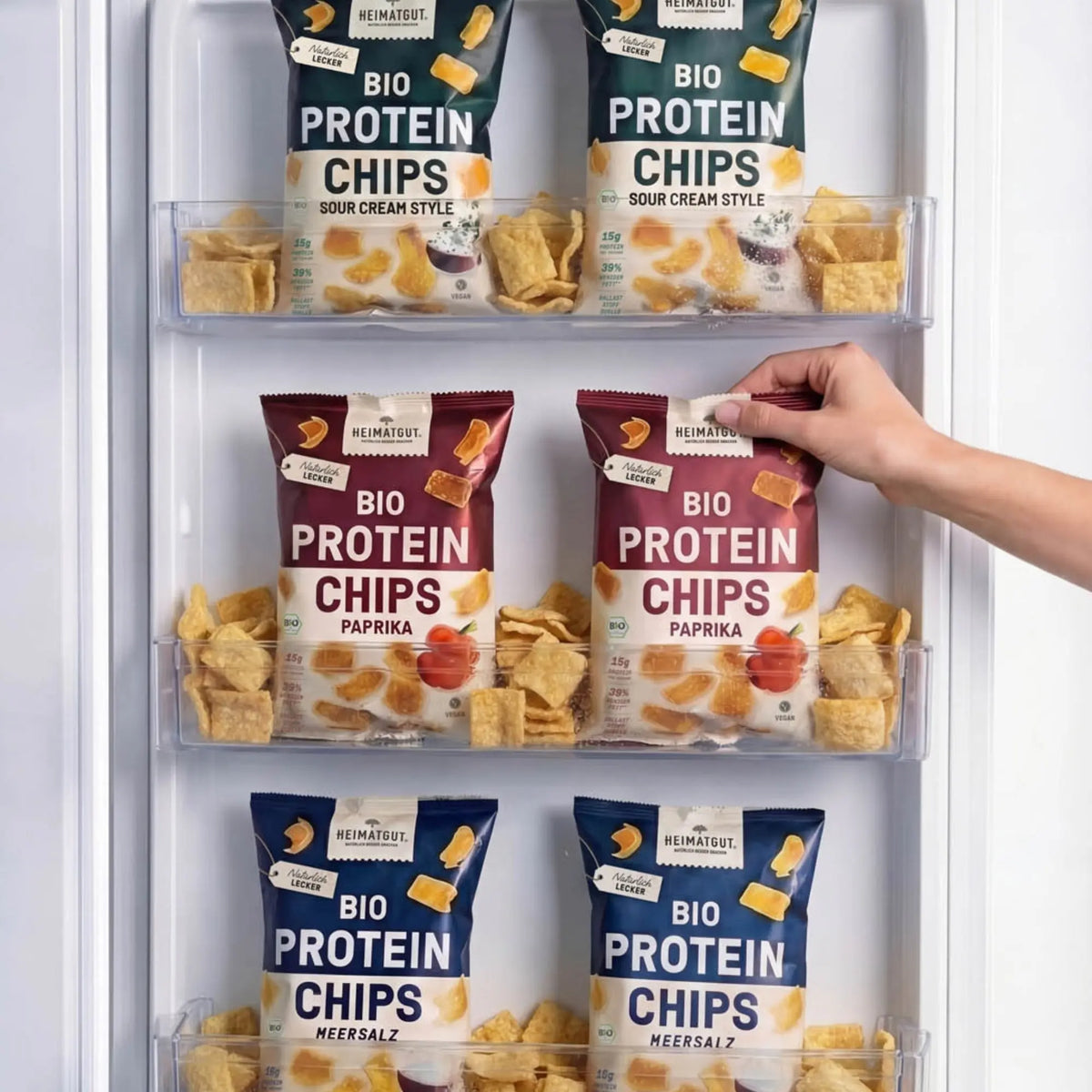
This is exactly where our Heimatgut Protein Chips come in: 26 g of protein per 100 g, 100% pea-protein-based, without sweeteners or artificial flavors. A 63 g bag = 16 g of plant-based protein between meals. More than most bars.
If you want to delve deeper into the whey vs. plant comparison: Here is our main article on plant-based protein →
Why whey is rarely optimal for women over 40
Whey powder has dominated the market for decades. But for the specific situation of women over 40, it is often not the best choice:
- High mTOR push — Whey strongly activates the mTOR signaling cascade. Great for muscle growth in young men. Considered critical in longevity research with chronic hyperactivation.
- No accompanying substances — Whey provides isolated protein without fiber, polyphenols, phytoestrogens. Yet, these very substances are particularly valuable for women over 40.
- Lactose and hormone balance — Around 15% of women in Germany have lactose intolerance. In addition, studies indicate acne triggers and possible amplification of hormonal fluctuations by milk protein.
- No satiety bonus — A liquid shake is significantly less satiating than solid, fiber-rich protein snacks. A real disadvantage with a slowed metabolism.
What makes Heimatgut different
Our snacks are not specifically developed for women over 40 — but they meet many needs particularly well:
- Plant-based protein from peas (Protein Chips: 26 g / 100 g)
- High fiber content (for many snacks 8–13 g / 100 g)
- Without artificial flavors, sweeteners, additives
- 100% organic certified
- Gluten-free available
- Convenient for everyday life — snack instead of powder, no mixer needed
The combination of protein and fiber is exactly what studies on women's nutrition after 40 repeatedly recommend.
→ To the Heimatgut Protein Box
Three takeaways
- More protein than you thought. 0.8 g/kg is too little. Aim for 1.2 g/kg.
- More plants than usual. Studies show clear benefits for frailty, inflammation, and longevity.
- Pay attention to distribution. Better to have 3–4 smaller protein portions throughout the day than one large one.
You don't have to completely overhaul your diet. A more conscious approach to protein and a few plant-based snack alternatives are enough to achieve measurable effects. Supported by one of the world's largest women's health studies.
→ Discover Heimatgut Protein Box
FAQ
How much protein does a woman over 40 really need per day? Current studies recommend 1.2 g per kg of body weight — for 65 kg, that's about 78 g of protein daily. The classic DGE recommendation of 0.8 g/kg is too low, according to new research, to effectively prevent sarcopenia.
Is plant-based protein really better than animal protein for women over 40? The Nurses' Health Study with 85,000 women shows: More plant-based = less frailty. More animal-based = more frailty. The conclusion is not "only plant-based," but "more plant-based in proportion" — a conscious shift towards legumes, soy, nuts, and protein-rich plant-based snacks.
Does plant-based protein help during menopause? Plant-based protein sources contain phytoestrogens — secondary plant compounds with estrogen-like structures. Soy protein is associated with milder menopausal symptoms in several studies. Legumes and whole grains also provide fiber, which supports estrogen metabolism.
Can I maintain muscle mass with plant-based protein? Yes. Several RCTs show that adequate amounts of plant-based protein maintain muscle mass just as well as animal protein. Important: total quantity (1.2 g/kg) and combining different plant-based sources for a complete amino acid profile.
Are protein snacks useful for women over 40? Very useful — if they are well made. Snacks fill protein gaps between main meals and distribute protein intake throughout the day. Important: Pay attention to clean labels (no sugar, no sweeteners, no artificial flavors) and prefer plant-based protein sources (pea, soy).
How do I best distribute protein throughout the day? Goal: 20–30 g per main meal plus 1–2 protein-rich snacks with 8–15 g each. This distribution utilizes muscle protein synthesis more effectively than one large protein meal per day.
Sources:
- Reid-McCann et al. (2025) – PMC, "Effect of Plant Versus Animal Protein on Muscle Mass, Strength, Physical Performance, and Sarcopenia: A Systematic Review and Meta-analysis of RCTs"
- Sahni et al. (2022) – Journal of Cachexia, Sarcopenia and Muscle, Nurses' Health Study Frailty Analysis
- Ishaq et al. (2025) – Frontiers in Nutrition, "Role of protein intake in maintaining muscle mass composition among elderly females suffering from sarcopenia"
- Li et al. (2024) – The Journal of Nutrition, Health & Aging, "Association of dietary protein intake, inflammation with muscle mass and sarcopenia"
- Bauer et al. (2013) – Journal of the American Medical Directors Association, PROT-AGE Study Group Position Paper
- German Nutrition Society (DGE) – Reference values for protein